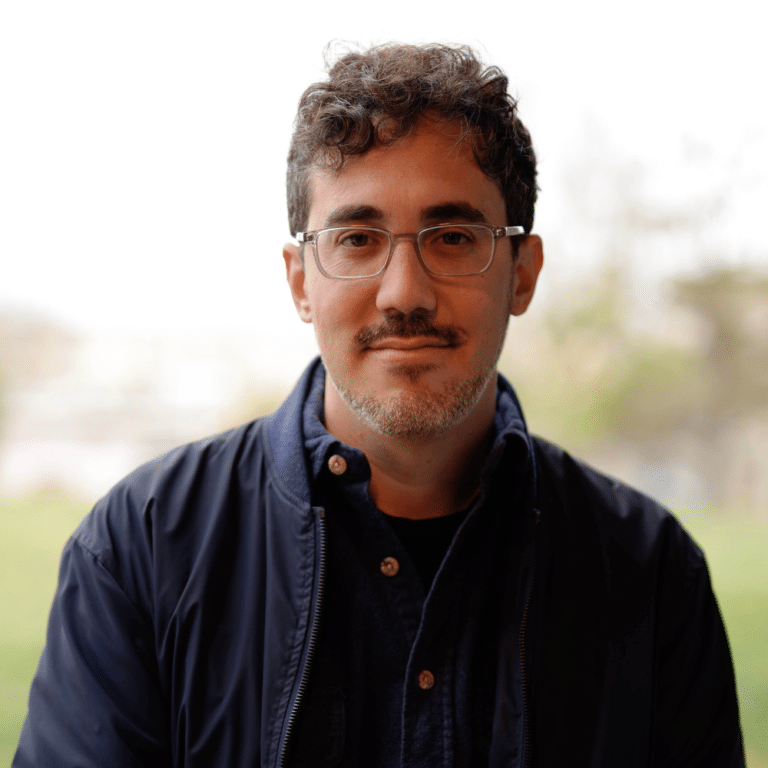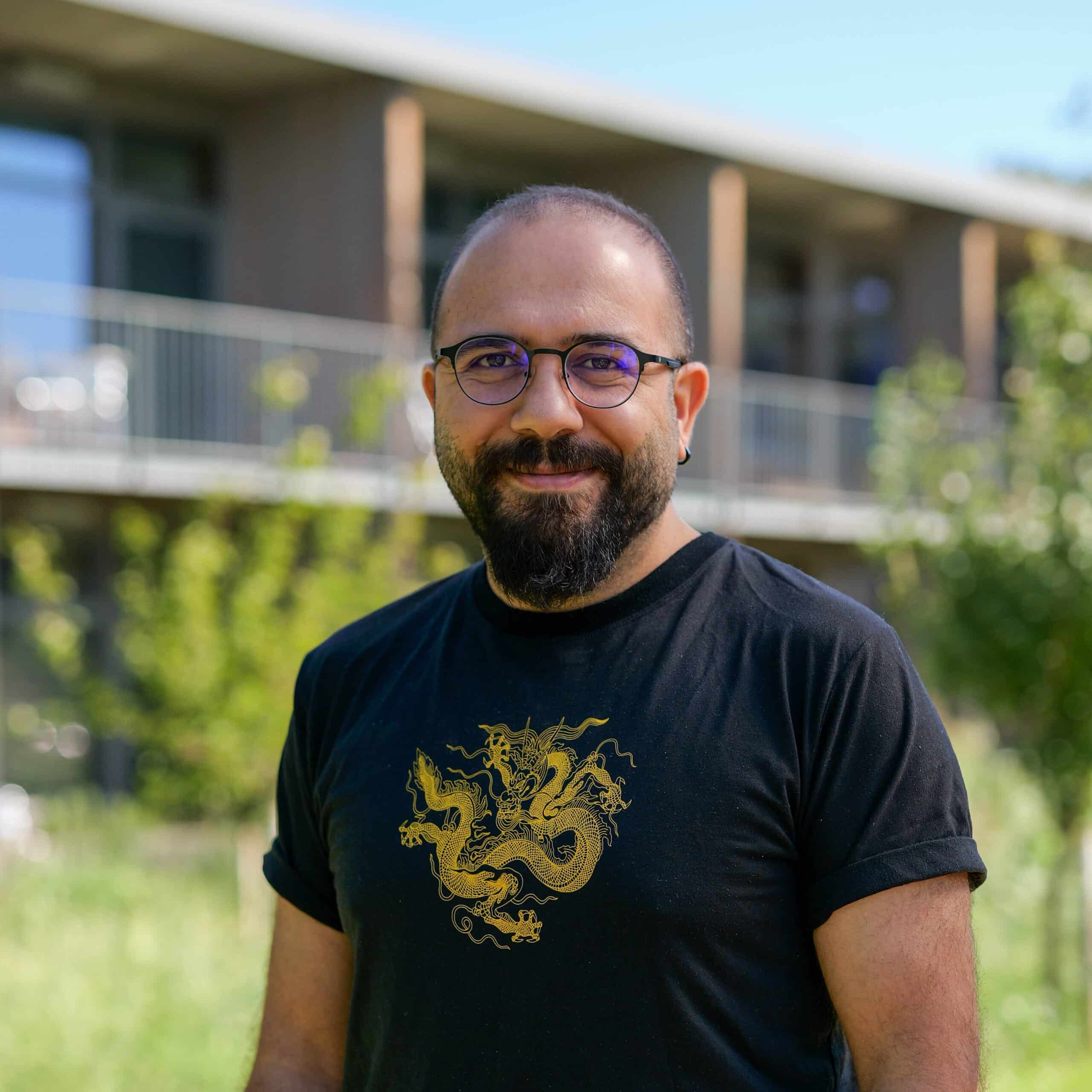
Crédit photo : RGxHB Production
Jan Yasin Sunca
Research project
Alter-democracy: Democratic utopias in face of the crisis of democracy
Project summary
Rethinking democracy against its liberal closure
This project starts from a simple but urgent paradox: liberal representative democracy and the liberal international order are in a profound crisis, yet the need for democracy remains unchanged, if not more urgent than ever. What appears today as the crisis of democracy is not only the weakening of institutions, the rise of authoritarian leaders, or the erosion of electoral norms. It is also the crisis of a hegemonic understanding that has reduced democracy to liberal individual rights, functional institutions, and “free and fair” elections. This understanding has become too narrow to respond to the historical moment it claims to govern.
The need for altering democracy therefore emerges from two interconnected crises. The first is the crisis of the liberal international order, visible in the increasingly dysfunctional character of international institutions, their inability to respond to ongoing large-scale massacres, wars, and ecological devastation, and the recomposition of violent hierarchies under changing world-political conditions. The second is the crisis of liberal representative democracy, which has shown itself to be structurally permissive of racist, sexist, nationalist, and classist political formations. In different parts of the world, authoritarian, exclusionary, and domination-seeking forces often use the formal procedures of democracy in order to hollow out its emancipatory content.
Against this background, the project proposes to think democracy beyond the rigidity of its liberal-representative form. Its aim is not to abandon democracy, but to rescue it from liberal ideological closure. It asks what can be learned from alternative democratic experiences that have emerged against domination, state violence, colonial hierarchies, patriarchy, racism, and exclusion. These experiences are not treated merely as empirical cases of social movements, but as materialised democratic utopias that innovate, integrate, prefigure, perform, and practise other forms of democratic life. The project names this field of inquiry alter-democracy.
Alter-democracy as mobilising utopia
The core issues that this research seeks to mobilise are radical democracy, direct democracy, movement democracy, revolutionary democracy, and feminist democracy. The project takes seriously the democratic innovations produced by movements and political projects that do not simply demand inclusion within existing institutions, but seek to transform the very meaning, scale, and practice of democratic participation. Although under existential threats due precisely to the domination of our time by realpolitik, experiences such as Rojava and Chiapas are central, because they have developed practices of self-governance, communal organisation, direct participation, and democratic autonomy against state-centred political logics. Feminist movements, including the international women’s strike, the Jin, Jiyan, Azadî movement, and broader women’s mobilisations in the Global South, are equally important because they rethink democracy from the standpoint of struggles against patriarchy, social reproduction, state violence, and gendered domination. Movements such as the Indignados, Black Lives Matter, and other anti-austerity or anti-racist struggles also reveal the limitations of liberal representative democracy while producing alternative forms of political participation.
Centrally, it seeks to capture not only what forms of democracy are produced from below, from the margins, and from the historical experiences of domination. But also, how these experiences rethink democracy, where they draw their inspiration from, how they resonate with one another, and what their limits can teach us. In other words, it returns to the ontological origins of the need for democracy and the epistemes attached to local experiences of being dominated. It aspires to learn from, and reflect back on, the democratic practices of movements that seek to make domination structurally impermissible.
The project “mobilises” utopia to make sense of the experiences of alter-democracy through two profound openings that late Fredric Jameson enabled. The first understands utopia as a historical exigency against ideological closure. From the standpoint of hegemonic power, alternative democratic imaginaries are often dismissed as unrealistic dreams. Yet, from the standpoint of the dominated, utopia is not escapism. It is a claim to truth against the violence of what is presented as normal, realistic, and unavoidable. Utopian thinking becomes the condition of possibility for different politico-social relations under construction.
The second conception focuses on the gap between the empirical present and the imagined future. The alter-democratic experiences studied in this project are located precisely in this gap. They are not the abstractions of “reality,” because they have already been practised. But they cannot be treated as completed models either. If a utopia becomes fully closed, fixed, and functional, it risks becoming another ideology of domination. Thus, the project approaches alter-democracy through its incompleteness, imperfection, and permanent need for critical engagement.
Collectivising the thought
Because democracy is itself a participatory process, the project is conceived as a collective intellectual endeavour. Its goal is to bring together researchers working on radical, direct, feminist, communalist, protest-based, and movement-based democratic experiences in order to collectively reflect on the meaning of alter-democracy. The project will be organised around three main moments of exchange. The first step will focus on the theoretical foundations of alter-democracy and the framework of mobilising utopia. The second step will focus on concrete experiences of alter-democracy, bringing together researchers working on different movements, regions, and democratic practices. The third step will be an open conference designed to share the project’s findings with a wider academic and public audience.
Ultimately, the project does not offer alternative democratic experiences as perfect models to be copied. Rather, it treats them as living, situated, and globally resonant attempts to think and practise democracy otherwise. In a moment when liberal democracy appears incapable of opposing its own destruction, alter-democracy contends that the future may depend on learning from those who have already been forced to invent democracy differently.
Biography
Dr Jan Yasin Sunca is an FNRS postdoctoral researcher at REPI – Recherche et études en politique internationale, at ULB – Université libre de Bruxelles. He is conducting a research project on the colonial legacies of the nation-state as a failed project of self-determination, and on struggles for decolonisation in postcolonial spaces, through the experiences of Rojava, North and East Syria, and Chiapas, Mexico.
He obtained a master’s degree in political science from ULB and a joint PhD in political science and sociology from Ghent University, Belgium, and Bielefeld University, Germany. His doctoral research focused on the emergence and materialisation of resistance against hegemonic world order(s), through a case study of democratic confederalism and the Kurdistan Workers’ Party (PKK). His research is situated within international political and historical sociology, particularly focusing on theories of the nation-state and democracy, experiences of statelessness, and the contemporary politics of decolonisation.
Jan Yasin Sunca holds a FIAS fellowship for 2026-2027.
The FIAS fellowship Programme is supported by the European Union’s Horizon 2020 research and innovation programme under the Marie Skłodowska-Curie grant agreement n°101217263.