Itay Lotem, holder of the EHESS/Iméra Chair in Transregional Studies 2025-2026, is organising a study day on the state of the public debate on race in France on January 13th and 14th, 2026 at Iméra.
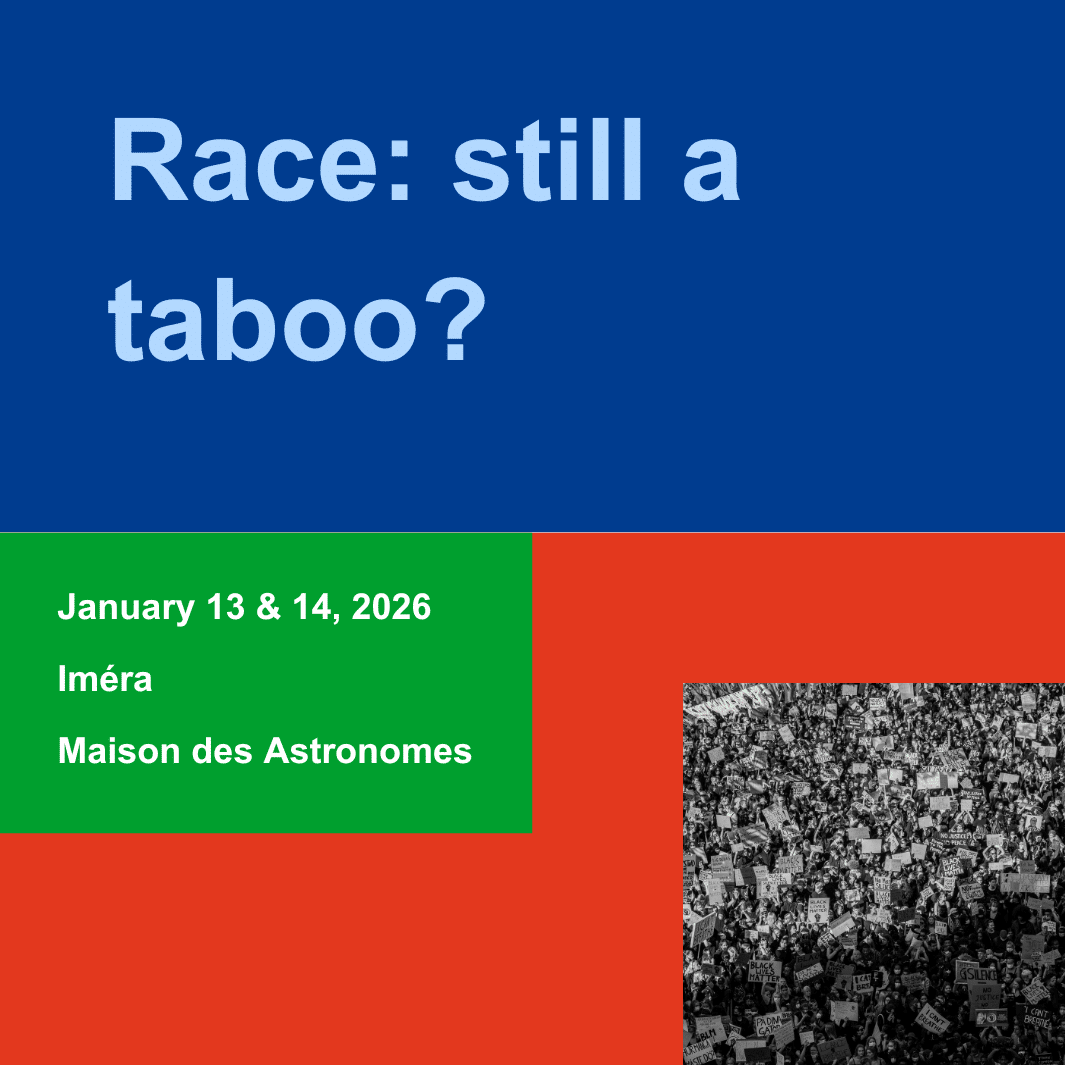
Examining the state of public debate on race in France
This two-day event will examine the public debate on race in France, and in particular the changes it has undergone over the last two decades. We will be looking at the shifts in the public arena between visibility and a continuing state of institutional taboo on the subject of race.
Traditionally, the French political debate has adopted a republican and universalist logic, said to be blind to skin colour, considering racism as a deviation or individual aberration in a State committed to the equality of all citizens. This logic equated the fight against racism with a desire to eliminate all distinctions between groups in order to remain faithful to a universalist ideal of “no distinction of colour”. As a result, the very word “race” was discredited because of its association with extreme right-wing theories of race and Nazism.
The French – and European – struggles against racism therefore focused on the idea of a “deracialised” society, excluding distinctions between groups and the vocabulary of race. This left no room for the interrogation of “race relations“, which implied considering race not as a biological category derived from nineteenth-century “racial science”, but as a social category that determines social relations and the understanding of difference in post-colonial societies. Nevertheless, the discourse of ‘racism without race’ leads to a contradiction: if the existence of racialisation processes cannot be openly explained, how is it possible to fight racism while making sense of the realities of diverse postcolonial European societies?
Combating the Republican “taboo”
In the mid-2000s, however, a new generation of activists emerged to denounce Republican “hypocrisy”. These activists developed discursive strategies aimed at combating the Republican “taboo” of addressing race as an anti-racist objective. To achieve this, they articulate the racial question by drawing on the Anglophone literature on race relations, and by highlighting postcolonial analyses.
However, with the emergence of new public debates on France’s colonial history and the ‘race question’, new contradictions have emerged in the French public, activist and academic spheres. On the one hand, the themes and vocabulary of ‘race’ gained visibility through heated debates. This was particularly the case when the growing attention paid by activists and academics to the issue of race provoked a backlash from republican and far-right actors. On the other hand, the violence of these debates only served to reinforce the discursive argument about the ‘taboo’ surrounding the mere act of talking about race. Similarly, in intimate spheres, the vocabulary of race has become increasingly important and used, often accompanied by an unease that only serves to demonstrate the weight of the social taboo that previously surrounded it.
To complicate matters further, these new debates have frequently pitted the “imported” nature of debates on race against a “French” republican model that was supposed to preserve the “colour blind” model as a republican utopia. But despite the acrimony, is ‘race’ still a taboo, or is it necessary to reassess its place in French public debate? To avoid perpetuating the same circular debates, is there a way to move beyond the taboo and address the changes brought about by today’s challenges? And what are the implications of these changes for the future?
Exploring this constantly evolving politicisation
The aim of this conference is to bring together experts and social actors involved, through their research and other activities, in the transformations of the public debate on race in France, to explore the meaning of this constantly evolving politicisation.
- How has the mobilisation of different players changed the focus and understanding of the race issue in France?
- How has the issue of race been politicised, both by anti-racist strategies and by far-right reactions?
- How have different players in France – activists, politicians, academics and journalists – interpreted the race issue through inspiration or contact with international thinkers and movements, and how have they articulated it publicly?
- How did the mobilisation and interpretation of the racial question cross different lived experiences, including intimate and public/institutional categories?
- To what extent is the term ‘taboo’, which has been an effective mobilisation strategy, relevant in describing the state of public debate at different times, and what are the future implications of such an acrimonious debate?
Programme
Tuesday, January 13th, 2026
Three round tables
- Time: 10 a.m. to 6 p.m.
- Venue: Maison des Astronomes, Iméra (2 place Leverrier 13004 Marseille)
Wednesday, January 14th, 2026 (morning)
Concluding session
- Time: 10am to 12pm
- Venue: Maison des Astronomes, Iméra (2 place Leverrier 13004 Marseille)
Wednesday, January 14th, 2026 (afternoon)
Walk around the Friche Belle de Mai.
Coming to Iméra
- Pedestrian access: come through the gate of the 2 place Leverrier, 13004 Marseille.
- PRM access: come through the gate of the Allée Jean-Louis Pons, 13004 Marseille.